
Flood Disaster
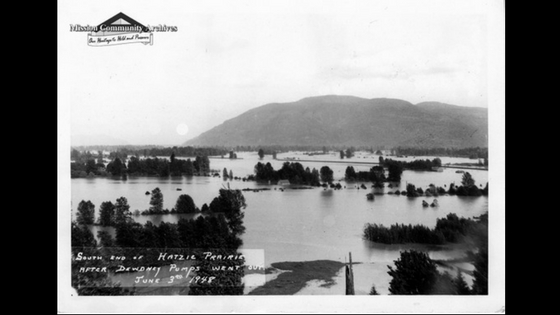

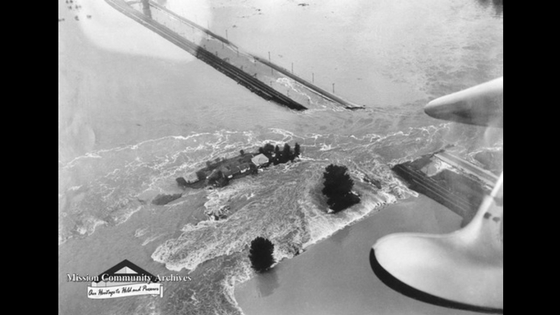
James Welton Horne’s decision to build the bulk of Mission City on the land between the Fraser River and the CPR rail tracks proved to be a disaster. The Mission flats had been subject to flooding even during construction of the town but low spring freshets in the following three years lulled the town into complacency. In 1894, the spring thaw caused the Fraser River to rise to a dangerous level and the newly constructed Mission City was soon submerged.
This was disastrous to the little town, and as soon as the flood level subsided, construction for a new downtown quickly took place uphill on Washington Street,(now First Avenue/Main Street). The new business owners could relax, knowing that they would forever be poised above any future flood threat.
Improvements were made to the Fraser River diking system, but this did not stop future floods. A small flood occurred in 1936, but “The Great Flood of 1948” was catastrophic, not only to Mission but to the entire Fraser Valley. The winter had been unusually cold and a late spring thaw had caused exceptionally high water levels. Although most Mission residents volunteered many hours of their time, tirelessly placing sandbags at the top of the dike to ward off the floodwaters, it was still not enough. The overflowing Fraser River in the Kootenay Region was a warning of the inevitable. The Westminster Regiment was called in for reinforcements in the sandbagging efforts, and bagpipers serenaded the workers to boost morale.
The dike in Agassiz was the first to break, submerging the small farming village and the rest of the valley soon followed. On May 29th, a loudspeaker system in downtown Mission broadcast that the dam at Nicomen Island had broken, galvanizing the citizens into immediate action to help. The worst, however, was still to come. On the morning of June 3, 1948 the pump house at Hatzic exploded into the air, creating a 100 foot gap in the dike which quickly widened to a staggering 550 feet. Water rushed through, destroying almost everything in its path. Residents watched in horror as the raging water rose above the train tracks. By dusk some 12 square miles of Hatzic prairie was flooded. Some homesteads were washed away completely by the rushing waters, and there were families left stranded clinging to the roofs of the buildings still standing.
Nicomen Island, Deroche, Dewdney, Dewdney Peninsula, Hatzic and the Mission flats were flooded – a total of 13,135 acres of agricultural land. 514 houses were destroyed, alongside barns and other buildings. A large number of livestock and crops had vanished. Fortunately, no human lives were lost in the Mission region, although there were ten deaths in other areas of the Valley.
The aftermath was challenging to everyone. Residents returned to their homes and were met by the smell of the rotting animal carcasses. Sludge coated all surfaces in the houses up to the water line and anything it touched was permanently stained black. Wooden floors and cabinets were warped, crockery was smashed and household furniture disintegrated when touched.
Fortunately, the emergency galvanized the province in terms of aid relief and volunteer labour. More than 30,000 civilian volunteers plus the Canadian Army, Navy and Air Force were placed on the flood ground to help the devastated region.
The Provincial Government spent over twenty million dollars of funding across the province for the rebuilding of infrastructure, with the majority of those millions absorbed in the Fraser Valley. While this helped pay for housing, seeds, feed, and poultry and helped farmers begin to reconstruct their lives, no recompense existed for lost crops or personal possessions.
The Red Cross administered a flood relief fund based on donations covering personal possessions and furniture. Locally, Lawrence’s and Mc & Mc featured relief furniture as well as special prices and terms of repayment on certain items. Those who qualified were allowed to choose from several different styles of new furniture displayed throughout retail stores in the Fraser Valley.
The flood transformed the agriculture of the region. The government implemented a conversion plan to help damaged farms become self-sufficient. For every acre damaged by flood, farmers received 150 credits. Approximately 585 cows, 4770 chickens, 1500 turkeys and 138 pigs were purchased in the Mission region, as well as 500,000 strawberry plants, 105,000 raspberry canes, and other berries. Its impacts were felt by the residents of the Mission for a long time, and the 1948 flood has become a landmark in Mission’s history.